TradingKey - Netflix (NASDAQ: NFLX) currently trades at around $82.23 and is now close to testing the $82.85 resistance level, having bounced sharply from its July lows. The fundamental picture looks solid, but is no longer solely focused on streaming. Netflix expects to hit $3 billion in advertising revenue by 2026, following a 13.4% increase in Q2 revenue. With expected Q3 growth slowing, the next leg of NFLX is likely to depend strongly on whether advertising and live programming can be scaled, along with margin discipline, to offset the expected slowing revenue growth.
Q2 Growth Stayed Strong, but the Q3 Guide Raised the Bar for Ads
Netflix reported $12.56 billion in Q2 revenue, an increase of 13.4% YoY. Operating income was up 11% to $4.19 billion, and operating margin was 33.4%, versus 34.1% in the prior year. Diluted EPS was $0.80, compared to $0.72 in the prior year. Overall the results were positive, but revenue was slightly below what analysts expected, and management's Q3 guidance left a clear gap for growth.
Netflix expects $12.86 billion in revenue in Q3, a 11.7% increase, with a 33.2% operating margin and $0.82 in diluted EPS. During the July earnings report, analysts expected $13.0 billion in revenue and $0.84 in EPS, thus creating the post-earnings sell off, and the gap remains even after the stock recovered in August. Full-year guidance is still expected to be $51.0 billion to $51.4 billion in revenue and a 31.5% operating margin.
Advertising Is Becoming the Clearest Fresh Catalyst
Netflix’s advertising business saw the most growth in August. On August 10th, Netflix said that, in line with expectations, commitments made during its 2026 US advertising “upfront” increased by approximately double the amount compared to 2025. The majority of the demand was concentrated for advertising surrounding live programming like the 2027 FIFA Women’s World Cup and the WWE and NFL events as well as MLB games.
This matters as Netflix is projecting a near doubling of its advertising revenue in 2026 to approximately $3 billion. The ad-supported service already has more than 250 million monthly active viewers and over 80% of members that signed up for the ad-supported service are viewing content on a weekly basis. In 2027, Netflix is planning to expand the service to 15 new countries which will increase the service’s reach and ad inventory.
On August 21, progress on the international opportunity was made when Netflix held its Mexico upfront. The company said that more than 60% of new global subscribers in markets that support advertising opt for the ad-supported plan. Also during the event, Netflix announced it would launch new advertising formats as well as new measurement tools and AI technology as well as the exclusive rights to the 2027 Concacaf Gold Cup and Nations League Finals in Mexico.
Live Content and AI Broaden the Growth Model
Netflix reported that viewing hours for the first half of 2026 hit a record 97 billion compared to 95 billion hours for the first half of 2025. A relatively small portion of total viewing time can be attributed to live programming. Similarly, live programming accounts for six of Netflix’s ten largest days of new membership sign ups over the past five years. As a result, management continues to invest in live sports, wrestling, and boxing programming as well as other live events.
AI is having an increasing presence in productions and advertising. For 2026, Netflix reported that roughly 300 titles used generative AI, primarily in post-production. For advertising, Netflix has adopted AI for creating ad formats, campaign planning, optimization and measurement. While AI does not eliminate the need for a good story, it can enhance production value and improve the ad platform for major advertisers.
Cash Flow and Buybacks Give Netflix Room to Invest
For the second quarter of 2026, Netflix recorded cash flow from operations at $1.74 billion and $1.53 billion of free cash flow. For the same period the year before, free cash flow was at $2.27 billion. The drop in free cash flow included higher cash outlays for taxes due in part to the Warner Bros. termination fee. Management still anticipates free cash flow in the range of $12.5 billion for the entirety of 2026.
Capital returns are still aggressive. In the second quarter of 2026, Netflix spent $4.7 billion to repurchase stock (an all-time repurchase record). Netflix has the ability to spend another $27.1 billion to repurchase stock. As of the end of June, Netflix had cash of $9.1 billion and gross debt of $14.4 billion. With this balance sheet, Netflix could continuously spend on content, innovation for advertising, and buy back stock. Netflix has not altered its capital allocation framework to reflect these new spending priorities.
What Could Disrupt the Recovery?
The primary concern is that subscriber engagement and advertising growth happen at different rates. A slower growth rate in revenue for Q3 (excluding the effects of foreign currency) is expected to further slow growth to 11%. Due to these concerns, the execution of the advertisement, pricing, and live programming will be of the utmost importance. The lawsuit against the name KPop Demon Hunters, which was filed by the plaintiffs against Netflix and numerous other companies, on August 18, 2026, is of interest, but does not appear to be financially material at this time.
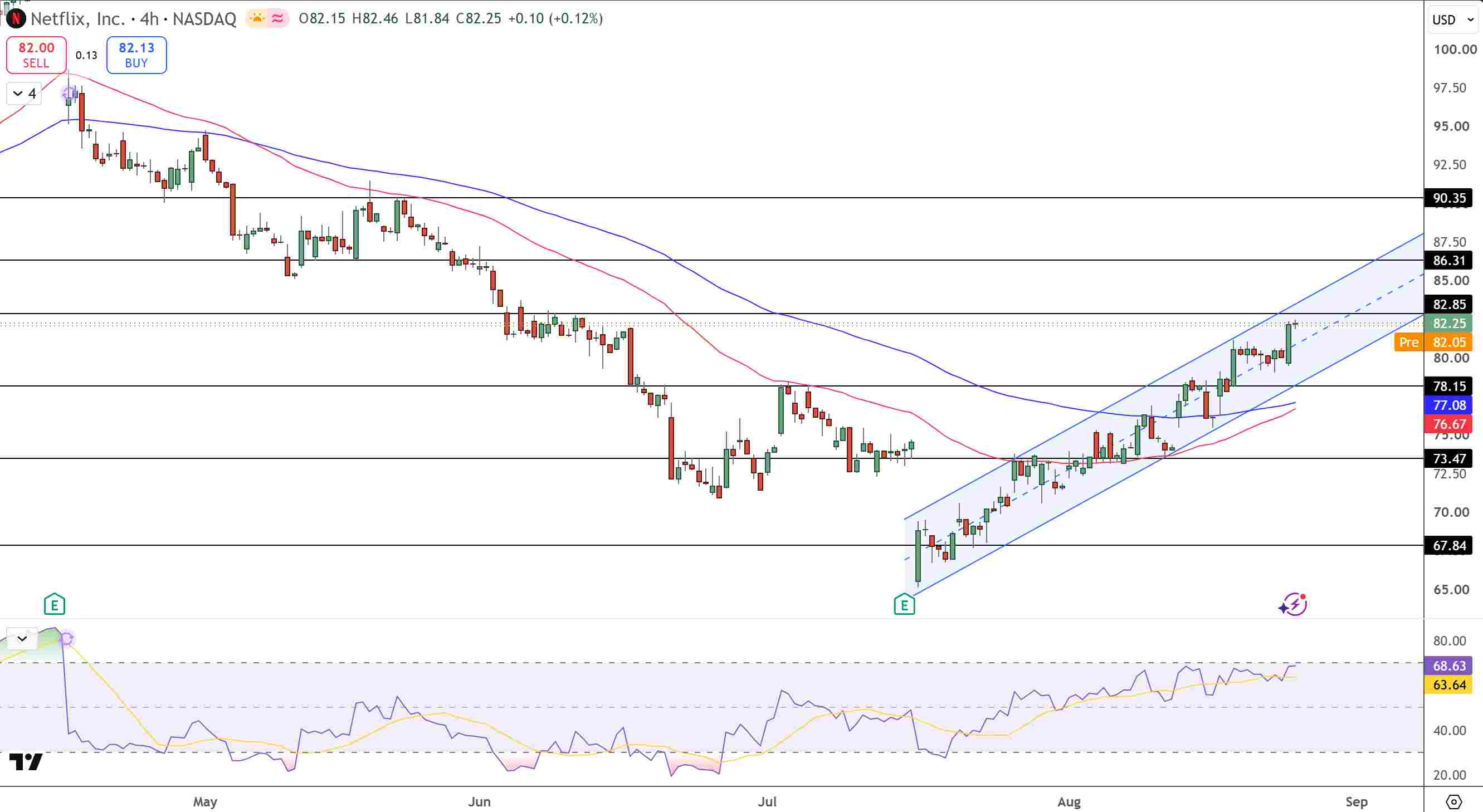
Netflix Price Chart - Source: Tradingview
The rebound is still considered constructive for Netflix. After reaching lows in July, around $65, shares of Netflix have since traded above their moving averages at $76.67 and $77.08. RSI (Relative Strength Index) is currently at 69, which is suggests bullish momentum, but is somewhat stretched. For this reason, a pause above support would be expected rather than considered to be bearish.
Can Netflix stock break above $82.85?
Above $82.85, we would have another higher high and the channel would shift in favor of $86.31 and potentially $90.35. If this level does not hold, we would look to $78.15 and the $77 area as our first support zones.
What is the biggest fundamental catalyst for Netflix now?
Advertising is clear the biggest fundamental driver right now. Nearly doubling of upfront ad commitments in the US, large scale global roll out of ad tier and taking the ad model to new international markets is the clear driver. However, it’s uncertain whether the growth of the ad business will offset a slowing subscription business.
Bottom Line
Netflix has become more fundamental than ever before. Q2 delivered double-digit revenue growth and high margin, while Q3 guidance showed that the slow growth of the subscription service would dominate. The burden of earnings growth now rests in advertising, live programming and technology. At $82.23, the improving narrative is reflected in the stock. Holding above $78.15 would push the recovery toward $86.31 and potentially $90.35.
Find out more